When I got this piece, my eyes boggled at the sheer difficulty of it.
My piano teacher had warned me in advance, saying “this piece is difficult and will take time, but it will help your technique tremendously”, something that I took in stride; I had nodded, determined, through the face time screen (my teacher held virtual classes in response to the pandemic of 2020).
But still. When I searched up the score online, and listened to some recordings, I remember feeling small. So, so small— a feeling I hadn’t had in a while when it came to piano. It was almost like I was six, sitting on a grand piano in front of an audience, playing my first performance piece.
Seven pages of so many notes. I have never been the best at reading music; my strengths lie primarily in my inherent musicality and interpretation plus memorization, but reading notes is always a huge hurdle that takes me a while to jump past. So seeing the music, with at least twenty-two notes per measure in quick succession… that scared me.
It also seemed like a challenging piece because it was fast. I would listen to the recordings while looking at the sheet music and find myself measures behind, the myriad of notes swirling in my head and going down the drain. It was an experience I also hadn’t had in a while; it had been maybe a year since I had last lost track of music when looking at a score.
Overall, I was terrified.
Not to mention the trills, and the complex interludes, the grace notes, the huge chords, the descending and ascending scales, the false simplicity of it all— I just kept finding things to be scared about.
However, from November to February, I would annotate my score from hell and back— you can see scan of my score below, and if you look closely, you can see me labeling notes so that I didn’t have to sight read them when practicing, labeling parts that repeated so I could memorize quicker and easier, circling sections almost desperately…
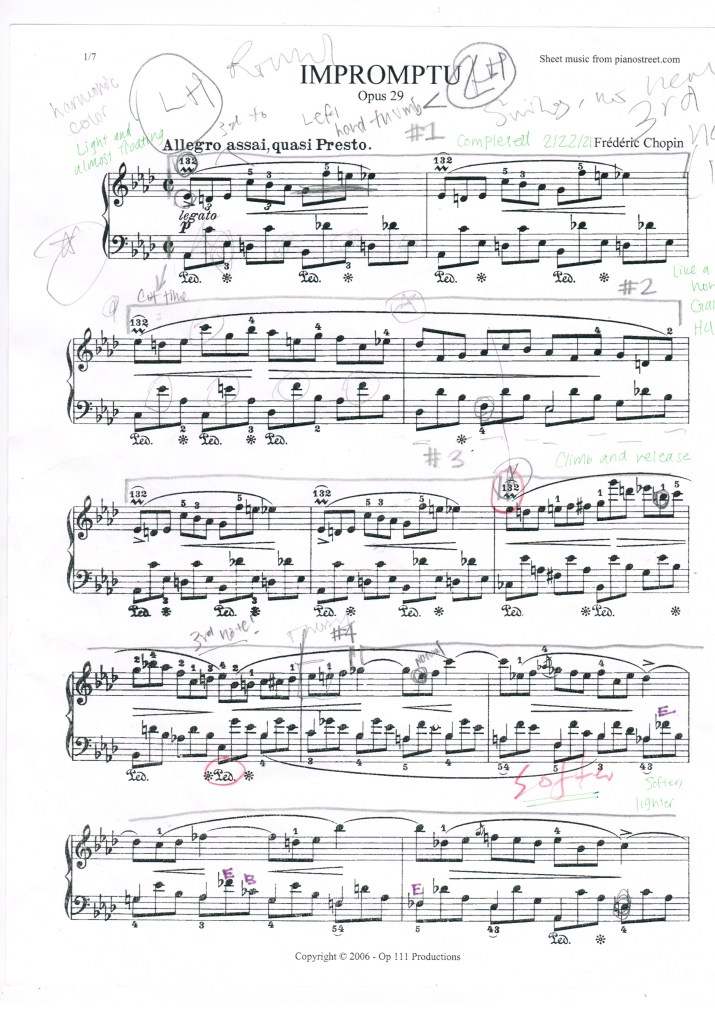
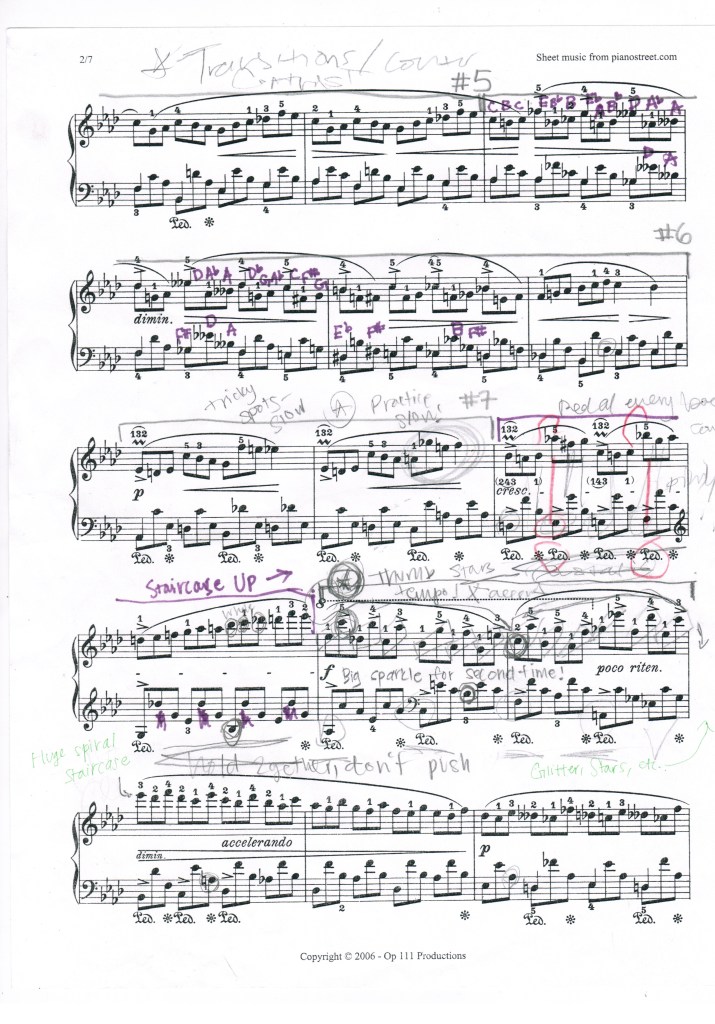
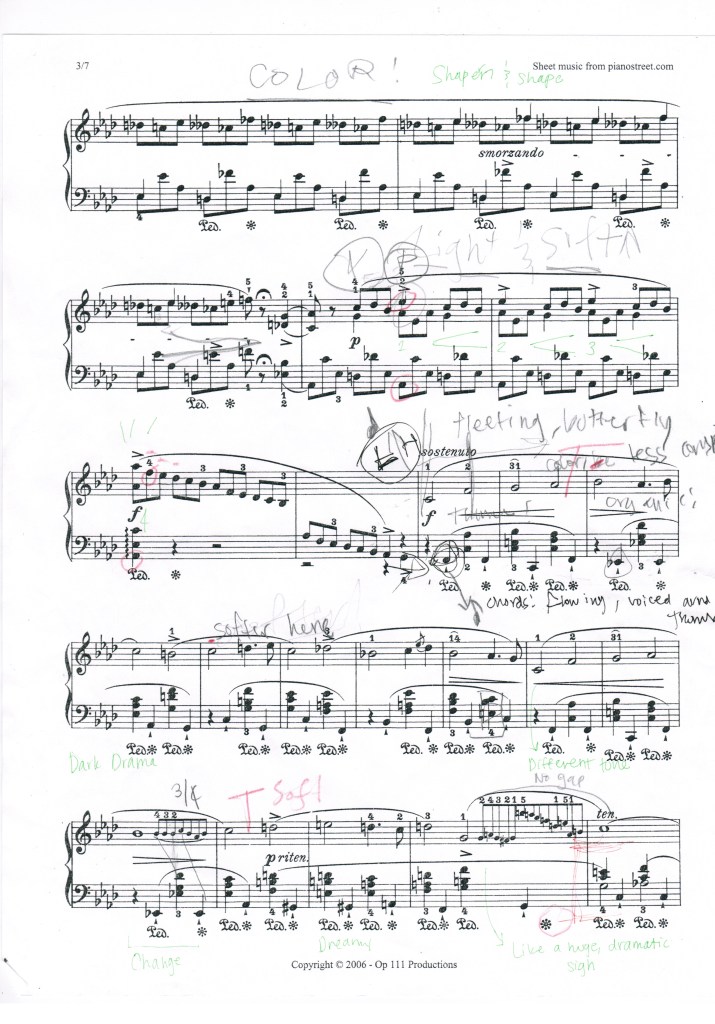
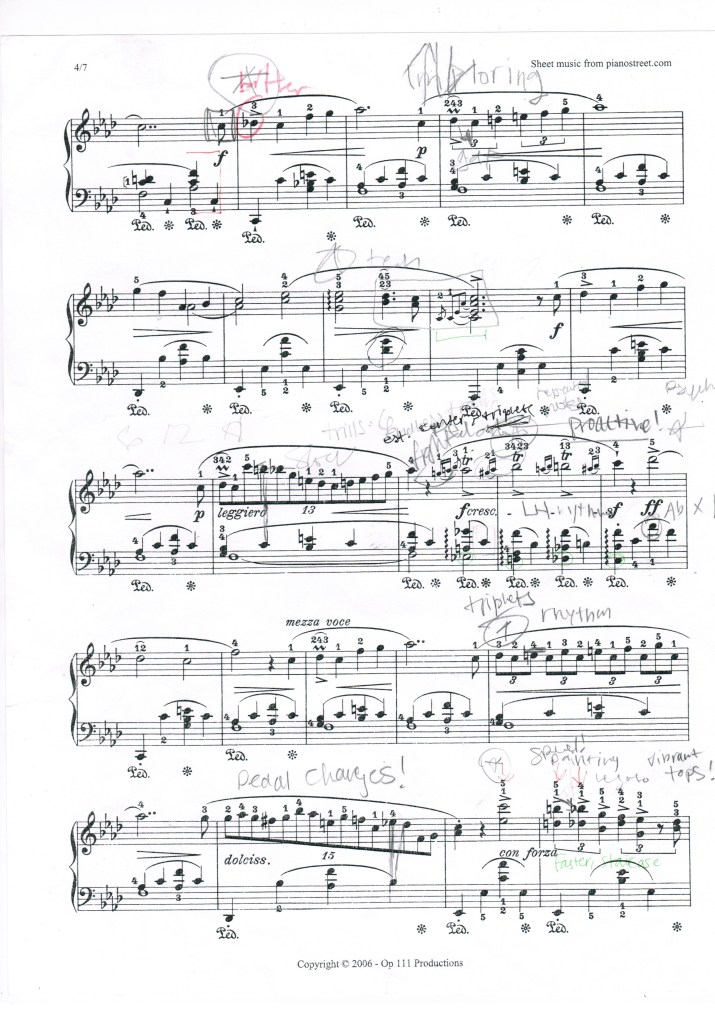
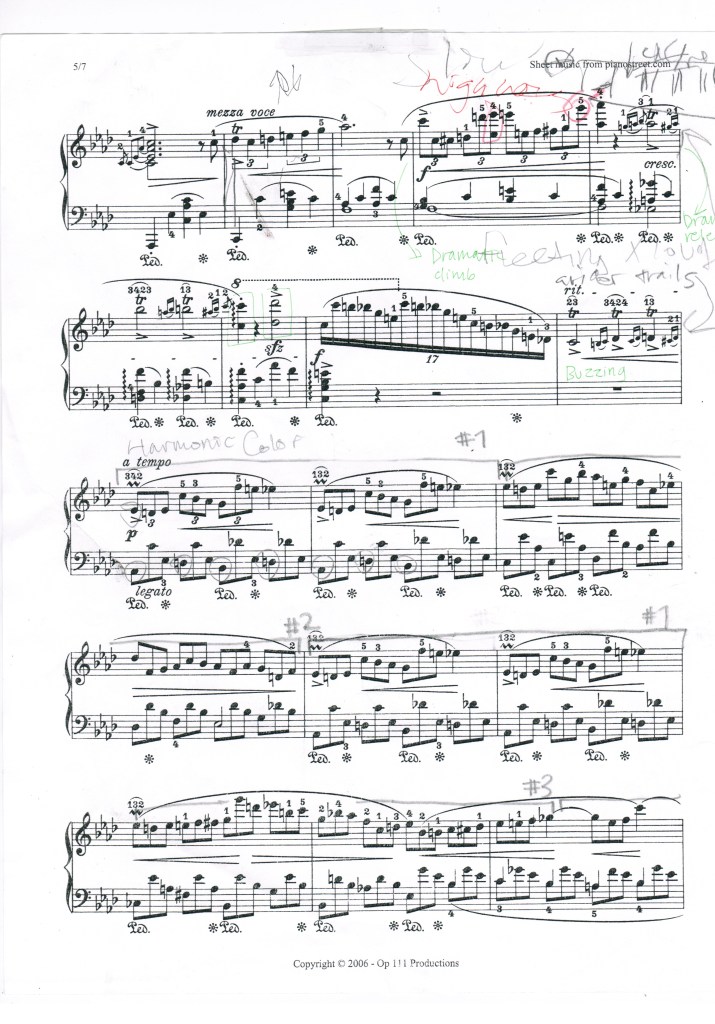
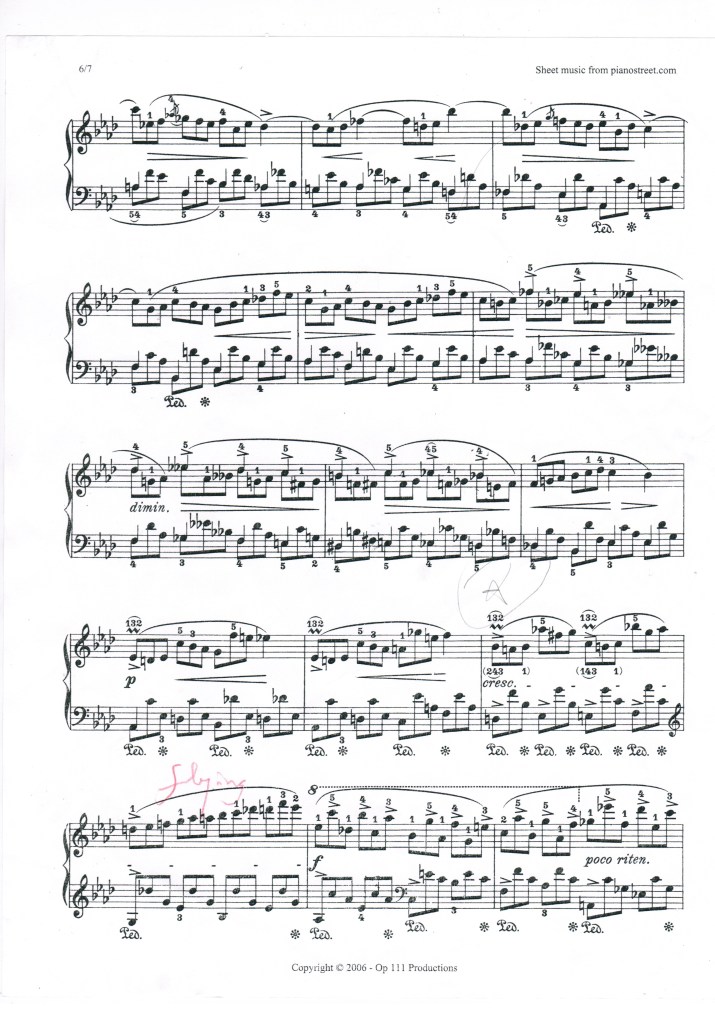
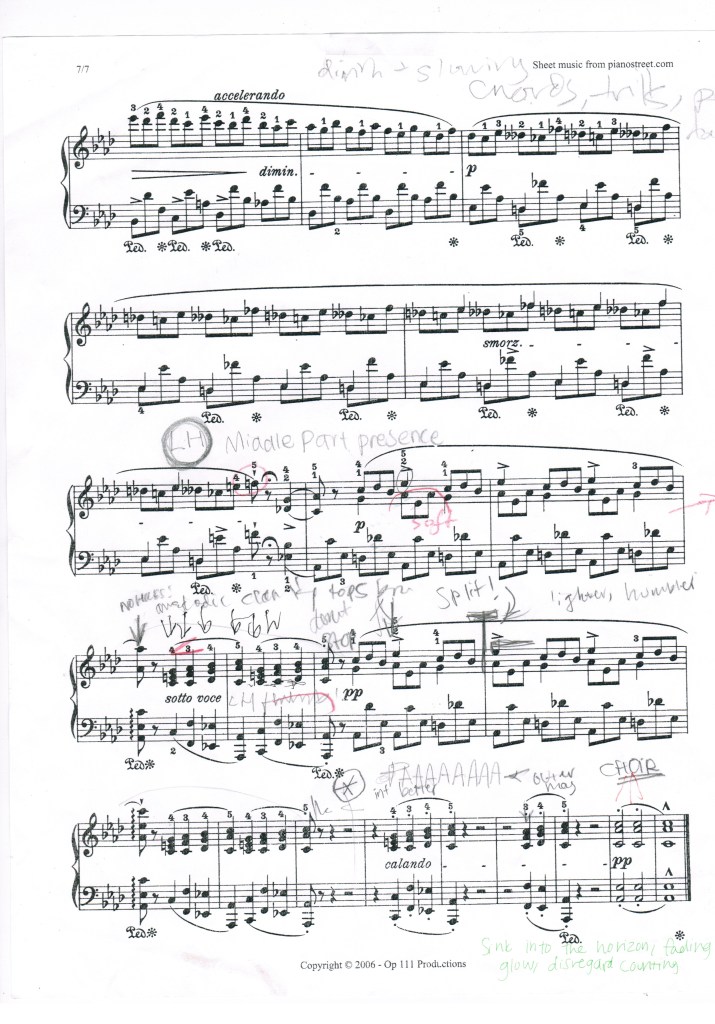
However, I was able to make it through the piece.
I remember there was one particular evening where I sat at my piano for two hours straight just practicing, going over notes and sections carefully— that was the breakthrough day, I think.
Almost in every piece I’ve practiced, there’s a day like that. When my brain just hyperfixates on piano, and I sit for so long that when I stand up my thighs peel from the leather bench like a bandaid clinging to the hairs growing on your skin— rather unpleasant, most of the time, but the products are always worth it.
After that, I was set. I knew the notes, I understood how they worked, when to play it, but now it was a matter of how to play it.
As I said before, this part comes rather easily to me. It’s in my blood, I think— or just being surrounded by music and being an artist in multiple medias helps me get a grasp for these things. If art is the act of interpretation, and I interpret things through writing, drawing, composing, and playing music, then I have a lot of experience with it.
It took me approximately one more month to grab ahold of the essence of the piece though. However, a blockade that I ran into was focusing too much on my spirituality; my technicality was eroding, and while my playing was musical, I started regularly missing notes.
I had a concert coming up that I had to record a playthrough for. This was before I had fixed my technical issues, and the recording was also made the first time I was meeting my teacher in a year; overall, the recording turned out mediocre, which was expected.
(You will not see this recording; it was used for the concert just because we didn’t have time to record another one.)
In the week between the concert and my final recording, my teacher informed me that he wanted to enter me into a few higher-level competitions than the ones I’ve competed in before (these include the Concert Festival competition, the Young Maestro competition, and many more prestigious competitions).
That meant that we had to fix my technique in a week.
In the end we decided on a drill that would prove to be very effective: playing the notes slowly, without pedal, in dotted rhythm. The switching of the rhythm would force me to lose my reliance on my muscle memory, and instead coerce me into memorizing notes where they hit and when they hit.
This ended up working, so on February 19th, I sat down at 4:00pm to record. My final recording is below.
 Melody Zhang
Leave a comment