In the year of 2019, my piano teacher suggested that I applied to the Crescendo International Competition (the Little Mozarts category) for a chance to win something. It was my first big competition; we didn’t go in expecting to win anything, much less to play at Carnegie Hall.
I played Beethoven’s Sonata Opus 49, Number 2, on my birthday. March 24th, 2019, at 1:15PM, I auditioned in a room on the fifth floor of a tall building in downtown NYC.
A week or so later, we got the comment sheet from the judge back, and an invitation to play in the first place concert at Carnegie Hall. There, I listened to my former competitors play their pieces in a lavishly decorated hall, dazzling in the harsh stage lighting.
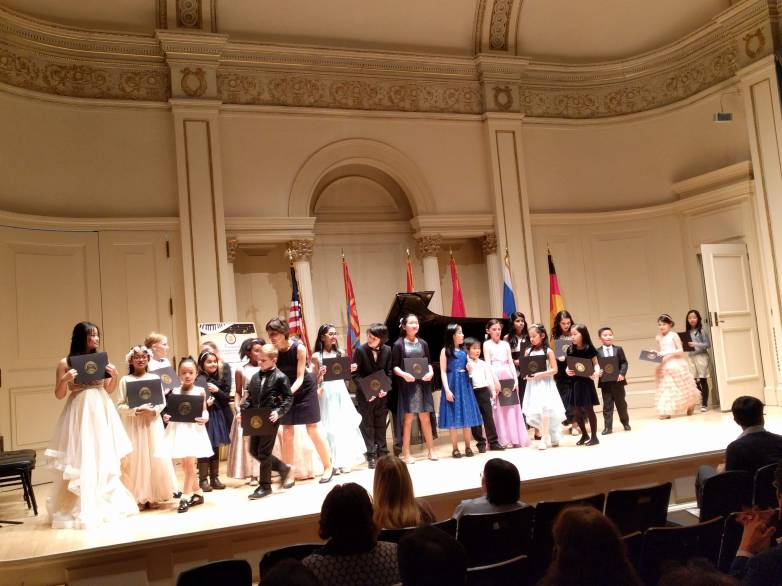
At the end, we were given out certificates; you can see that, along with the comment sheet, below.
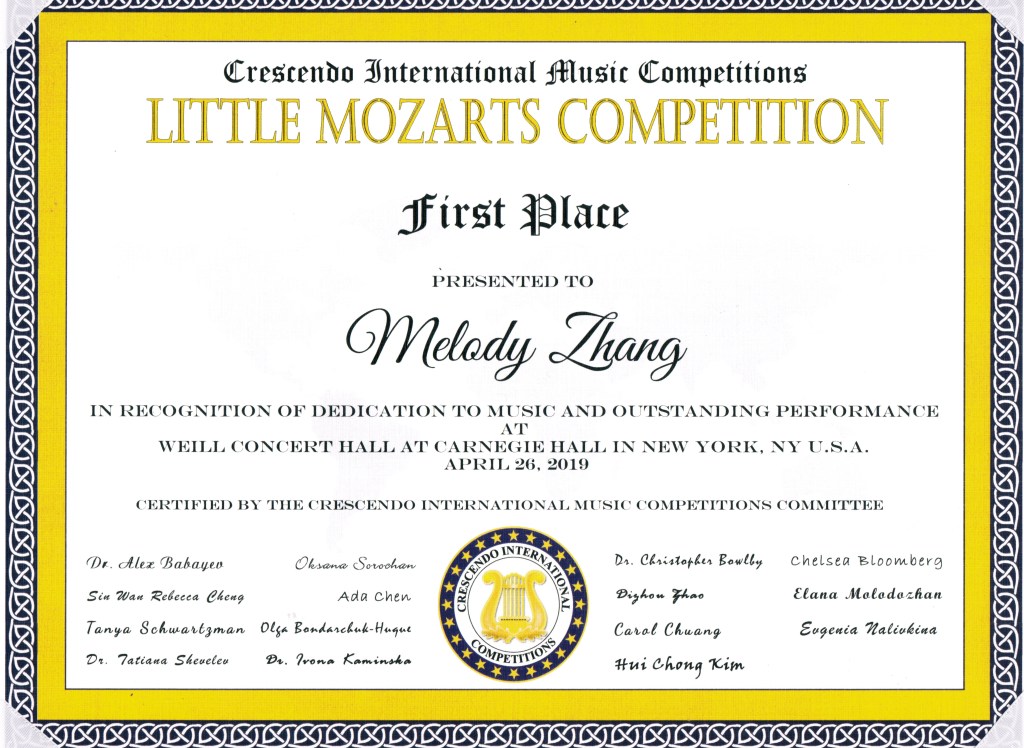
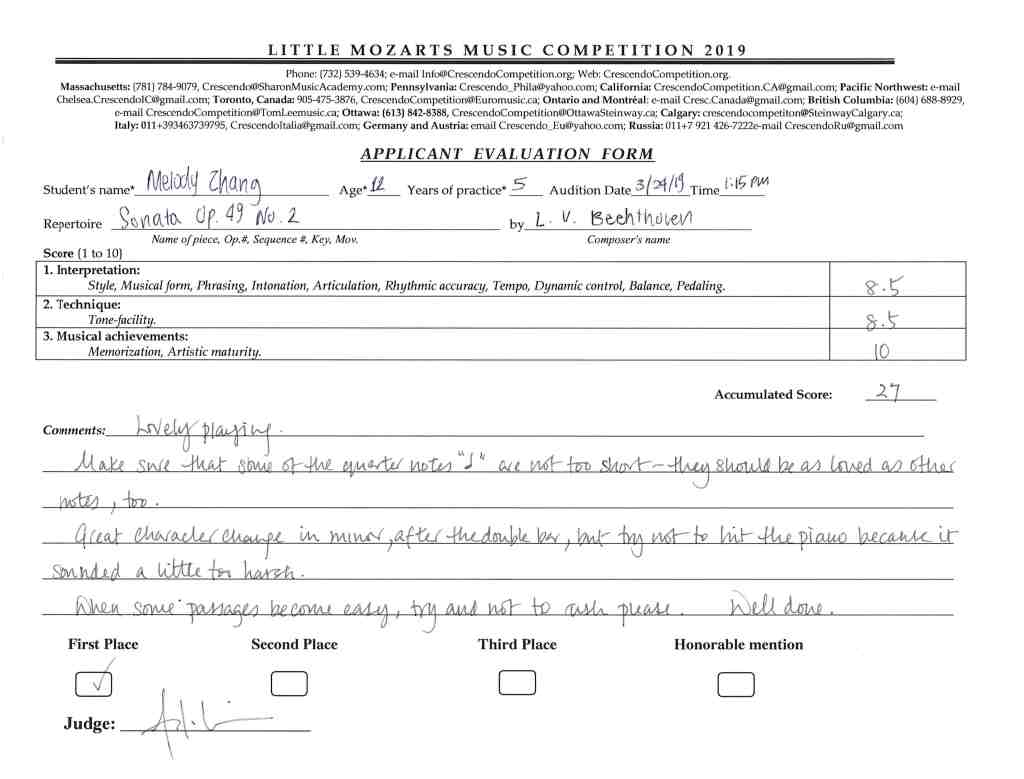
A while back, when I still wasn’t playing because of a few troubled years with the piano, I watched my brother play in the same hall.
He won a huge competition, and he, along with the other winners, was invited to play at Carnegie Hall for a similar concert. I went to watch not because I wanted to, but because I had to. I was too young to be home alone, and he’s my brother- even if I wasn’t interested, I would’ve gone to support him.
You have to understand that at that point in life, I hated the piano. I didn’t understand people who stilled played it- they could be drawing, I thought, or reading novels (two interests that captivated me at that time). All my memories of the piano were of pain, stemmed from a particularly strict teacher I had dropped just a few months prior.
There was this one kid at the recital though, that I particularly remember. I was sitting backstage with my brother, who then left to practice, leaving me alone with the other contestants. This young boy, with a bob cut and brown hair, was folding a paper airplane- he wasn’t much older than me at the time. Maybe nine or ten.
He kept kicking the chair, and he kept talking to me. “Are you performing too?” He asked me, to which I had shook my head to. Then he said, “I’m excited,” and went back to kicking the legs on his chair.
Perhaps I would’ve forgotten him if he hadn’t done anything else. Perhaps he would’ve been just some stranger out of the thousands I’ve surely met in my life- but he isn’t.
He played pretty early on in the concert. Him, still young, with stubby fingers and baby fat on his cheeks, walked on stage from the door to the left, black flats clicking under the applause, sat on the bench, breathed in, and played.
He played like he was free. He played like he was having fun. He played like flames would burn wicks- consuming yet contained, melting its source in bright light that radiated a dangerous warmth, flicking and searching for more.
Throughout the whole ordeal, he kept kicking the bench to the beat. He was smiling, brows furrowed in concentration, like he was having the best time of his life.
He confused me.
I didn’t understand him. I clapped softly when he finished, watched as he practically jumped from the bench and bowed dramatically, the whole time smiling.
To me, music was a cage. Notes are the tallies on the wall, measures are the bars constricting you, the key and time signature the wardens. There is no room to be free, no room to sing, or to burn, or to play.
He’s one of the major things that helped get me out of that dark place, and I realize that in hindsight. At the time, he was simply insane to me. One of the people that don’t realize yet, one of the people dancing in that little prison, eyes closed, hiding from the truth.
In 2019, I was backstage in that same place, in my thick navy coat that wrapped tight around a glimmering silver dress underneath. I stepped out of the elevator, and a woman in a tight bun high upon her head greeted me. She said, “Are you performing tonight?”
I nodded. She pointed me to the coat rack, where I discarded my jacket, pinned the silver bow I had bought with me to the back of my head, and rubbed my hands together to warm them. I hadn’t worn gloves- strangely, that’s one of the most vivid things I remember.
For the first three hours of the concert, I wasn’t supposed to play. The thing about having a last name that starts with the last letter of the alphabet is that you’ll almost always be last- this recital was no different.
However, there was this other girl, three years older than me. Her last name was sorted behind mine, and thus she was the last to perform and I the second last. We sat next to each other in line, ordered by when we would play, and she had the frilliest white gown I’ve seen on anyone younger than seventeen.
She was also extremely beautiful: prim eyebrows, lush lashes, dainty lips coated in a fine layer of pink lipstick. She smiled at me, asked me what grade I was in, what piece I was to play.
She was, from what she told me, someone incredibly talented with the piano. “I learned this piece, like, a day before the auditions,” she whispered to me from the balcony where all the performers sat. “I was supposed to submit this other piece, but my teacher wanted to challenge me, so he gave me this one. It’s two levels above.”
When all the other pianists played their pieces, she hummed along, fingers dancing in her lap, playing an imaginary keyboard- she knew all the notes, knew the pieces, but even still she was enraptured by the performances. It would’ve been intuitive to think that someone who’d already heard the same pieces over and over, pressed those keys for those sounds repeatedly, would find the three hour ordeal hellish. But for her, during all the interludes of applause, she would lean into my ear and say, “God. They played that piece so interestingly.”
This statement, if said to me a few months prior, would’ve made me scoff- or at least stare blankly at you in confusion. But at that time, in that concert hall, it made sense to me.
It all made sense to me.
When it was my turn, she gave me a little pat on the back, and I walked on stage. The stage lights, which were placed above and on the right and left of the auditorium, stared back at me- they were so bright I could barely make out the dark faces in the crowd.
On one hand, the watchful gaze of the audience made me shiver with discomfort. On the other, I didn’t even care. It was an inner dilemma between cowering under the pressure of others, and wanting to play a piece freely, the way I want to.
In the end, this conflict boiled down to a simple question: who do I play piano for?
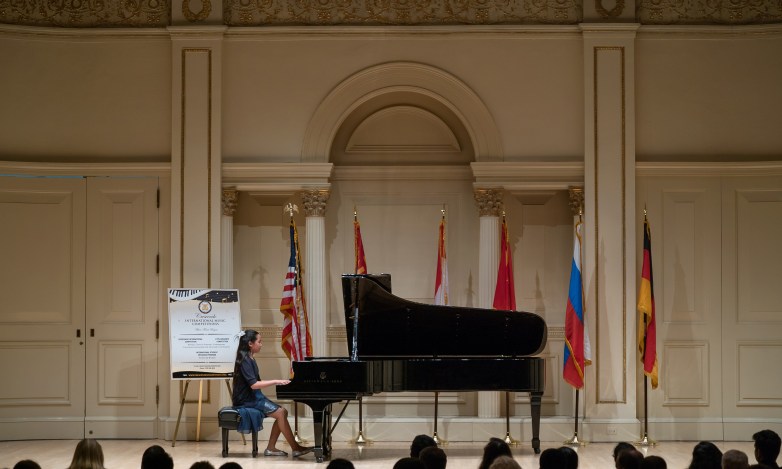
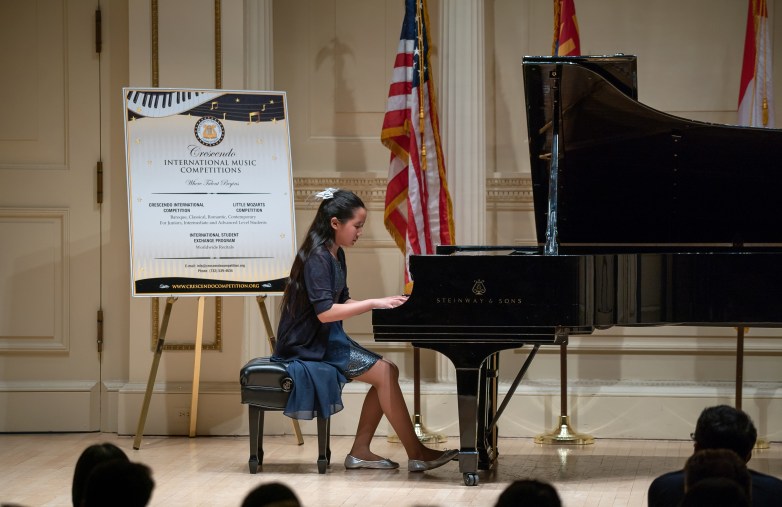
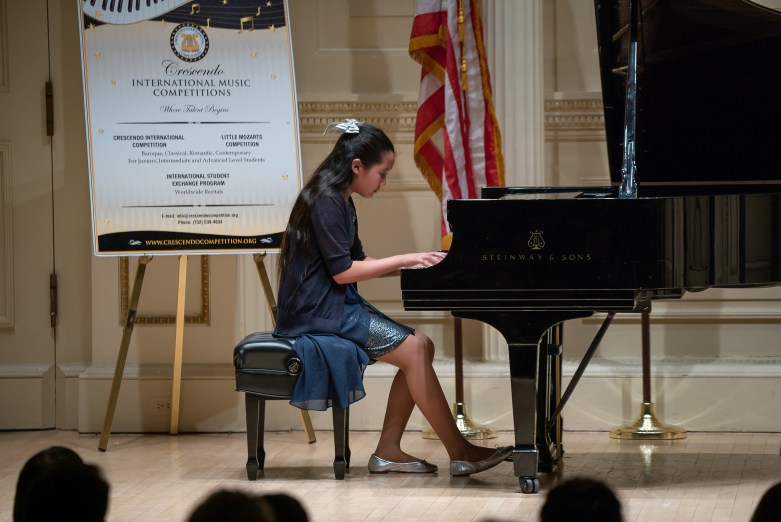
Slides 1, 2, 3: Pictures of my performance.
Slide 4: Picture taken by my mother during curtain call, with all the performers holding their certificates.
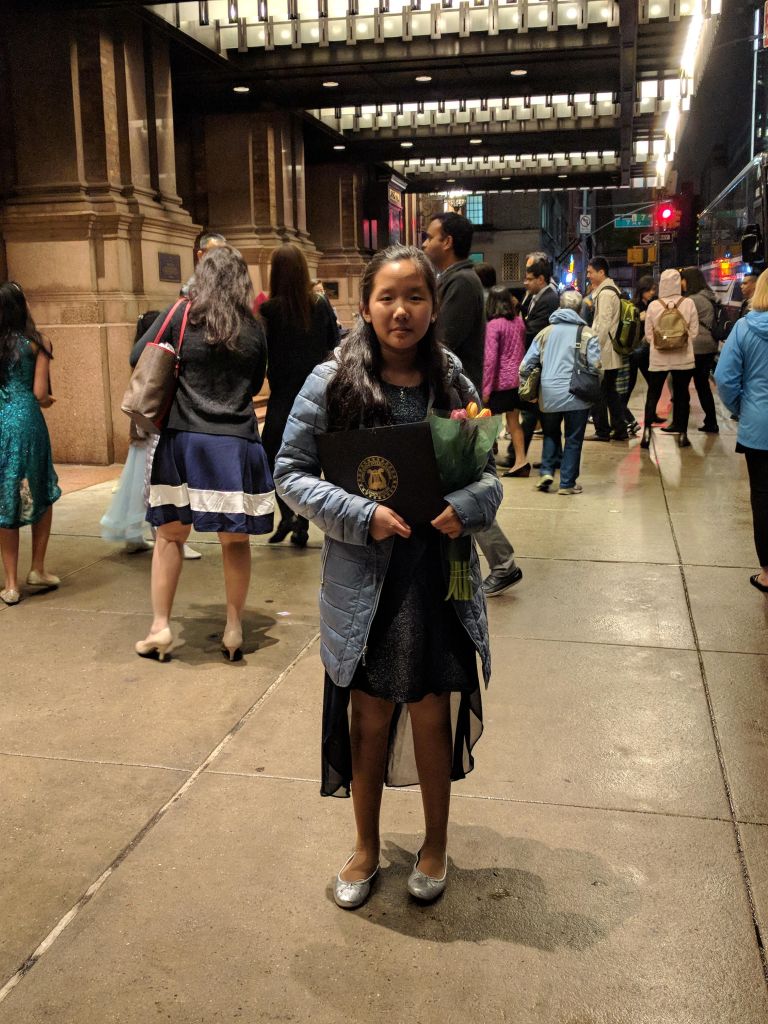
Slide 5: Picture taken after the concert, outside Carnegie Hall, my holding my certificate and flowers that my mother had gotten me.
My whole piano journey, I have played for many people. I have played for my teachers, have played for my parents, have played for judges, have played for myself. Typically I can distinguish between who I’m playing for- during lessons I play for my teacher, during recitals I play for the audience and my teachers, during auditions I play for the judge. When I’m alone in the living room with a keyboard, fingers dancing, I’m playing for myself.
But there in Carnegie Hall, I didn’t know who I was playing for.
I could have been playing for my brother- after all, he was the one who learned piano first in my family, and one of my biggest inspirations in my musical career thus far. I could have been playing for that little kid backstage in 2016, the one I worked three years to understand. I could have been playing for my parents, asking for validation in winning this award. I could have been playing for the audience, for the judges that allowed me the win, for the girl I met before the performance that would play after me.
I could’ve been playing for me. I could have been dancing on that stage in joy, in thankfulness for finally figuring piano and music out again. I could’ve been playing for anyone.
Even today, it’s a mystery who I played for in that moment. It’s something I think about before every performance now- in the bathroom doing my hair in the mirror, I think, who am I playing for today?, and sometimes I find that I know immediately while other times I pause in my movements and stare at the wall to think.
There are so many things I discovered in that hall, be it from 2019 or from 2016, with a little boy that kicked the chair both back and on stage. It was a signal to me, and to others, that my love for music was rekindled; but it was also a beginning of thought and purpose.
Who am I playing for today- and who will I play for tomorrow?
 Melody Zhang
Leave a comment