In remote learning, our art teacher had to improvise. I suppose it’s rather difficult to get a group of middle schoolers to pay attention to a screen (yes. Sarcastic statement to play into the “y’all always on y’all’s phones” thing, which is objectively true, but none of us will actually admit it because teens won’t face any problem other than large, societal-level ones that can give them online validation [this is a statement that is suitably described with the modern word “based”]) in the first place, so props to Ms. Thompson.
But yeah. She had to work around not actually being able to help us in person, so when we got to our digital art unit… we basically listened to the song “A Million Dreams” from The Greatest Showman, and then devised themes from it. After taking an overall vote, the dominating theme would be the topic to produce art of. In the end, Hope won. Fitting, in my opinion: the song is that kind of cheesy “I know the future will be well, and all we must do to reach it is believe in ourselves” way. The song is embedded below.
(Spoilers for the movie in the following paragraphs, by the way.)
The thing about the song is that it’s actually rather dark. In it, our protagonist, Phineas, is progressing through his first few decades of life. We start in his childhood, when he meets our deuteragonist and main love interest, Charity. They find a cool abandoned mansion, and then Charity and Phineas get married, Charity runs away from her overbearing dad into the city, they get kids, something like that.
It’s notable that “A Million Dreams” is pretty centric on the love interests. If you’ve watched the movie, you know that the climax of the main romantic plot is when Phineas ends up kissing a woman named Jenny Lind on stage, effectively betraying his trust with Charity— which was already waning because Phineas decided to neglect her and the kids to accomplish his own business-related goals.
What I’m saying is: “A Million Dreams” is not just about Hope, but also about the dangers of it. The blatant connection of it to the song “Never Enough”, which is the song Jenny sings before kissing Phineas, is telling. “A Million Dreams” claims that all it takes is a million dreams, while “Never Enough” responds to it with Never enough, never enough, never enough…
To hope, you must disregard a fragment of reality. You must become at least partially blind. And the danger with becoming partially something to anything is that you don’t know when to stop ignoring things. And thus, hope is a rabbithole that Phineas falls into, and “A Million Dreams” explores such with the power of ✨ connection to future plot ✨.
So, I went looking around online for a simple something to sum up hope, that also happened to go with what I thought about Hope as expressed in “A Million Dreams”. That’s when I found the following riddle:
“A fleeting phantom born at night
When all the light has gone—
Blind men follow in its wake,
Until it dies at dawn.”
It compares hope to light, and yet it also compares those that hope to blind men, who would logically not be able to see light. I personally think the men are specifically blind, because to have hope, you have to ignore reality to some extent.
The poem also says that hope appears in the night, only when times are “dark”: hope is that for a better future, and things can only be better if they were originally worse. I tried to think as carefully about this as possible while also putting it into my painting, which I will explain in more careful detail.
I’m not quite sure how to explain my thought process here, since it was really just instinct… but I can explain to you my literal process. I first started brainstorming ideas with small digital thumbnails, considering specific colors and composition, including symbolistic imagery, fitting in as much as I could. After that, I found reference photos (and, actually, in my final idea, this step was basically impossible. I go into depth on this subject later in this rubric), then I started drawing and painting.
The original thumbnail can be found below, if you would like to see what I started out with.
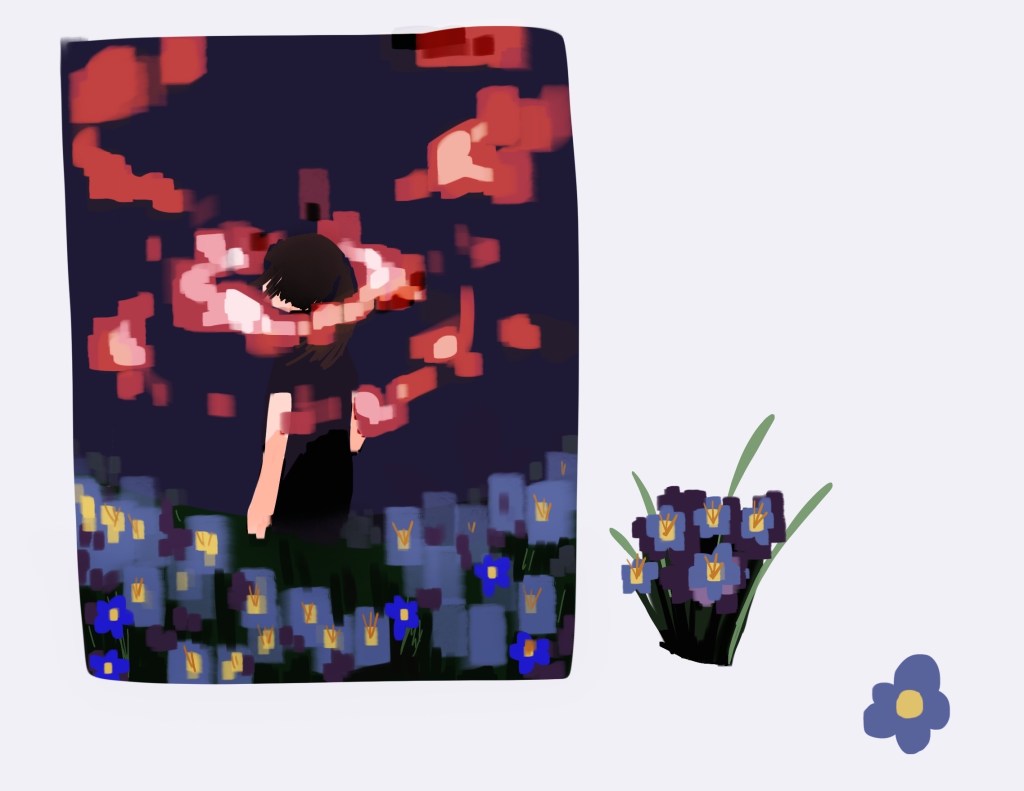
(The specific flower I was using was a forget-me-not: commonly symbolistic for hope, but there’s also a deeper meaning that will be explained later.)
I used Procreate, with my iPad Pro and Apple Pencil, which gave me a lot of opportunities for fancy digital things and more. It was my first time using Procreate— and also just my first time doing digital art in general, so I had to figure something out before I could draw what I wanted to draw. I used the overlay and layer options a lot, and also tried some textured brushes (the HB pencils, some from the industrial section, and calligraphy brushes for smoother lines). I used overlay for light – and the importance of light is something I do explain later – and the textures just made it pop.
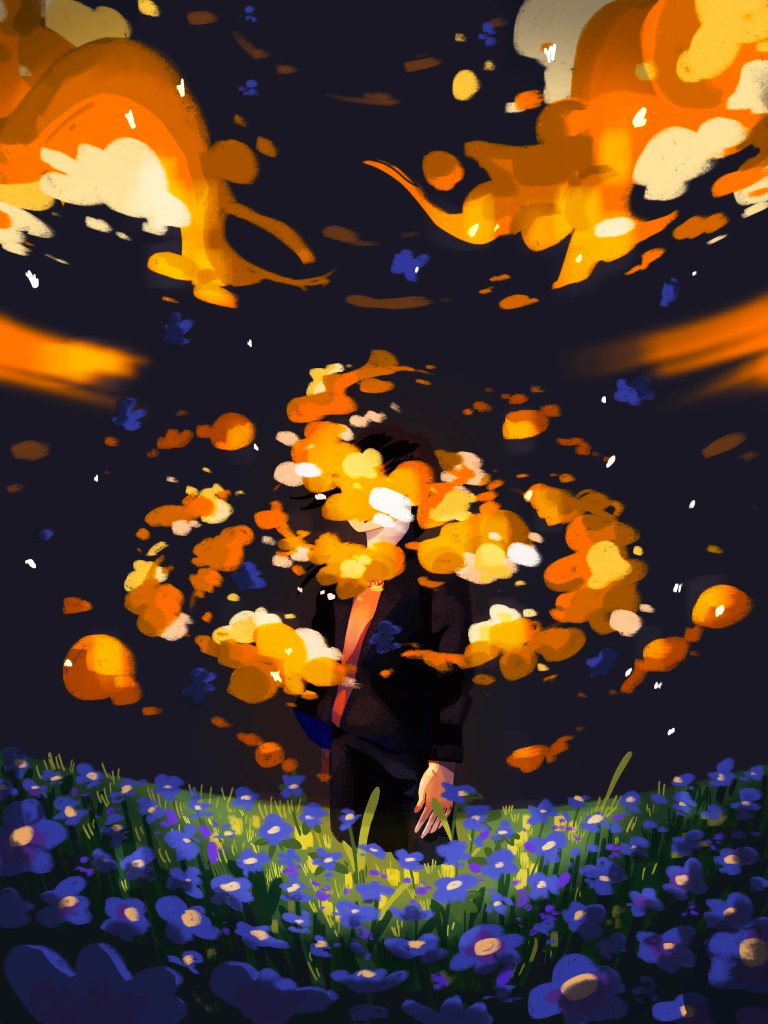
I did most of the components on separate layers. I drew the figure on one, the flowers/ground on multiple ones just to get that nice layered effect with the person in consideration to how the background would interact with them, and then I put the clouds over all those. After that, I just added a few touch up layers. But after a few hours of working, I turned out with the final product:
And now: a few paragraphs to explain my idea of imagery and symbolism in this piece – I will be quoting and referencing the riddle as I go, so maybe have that next to you.
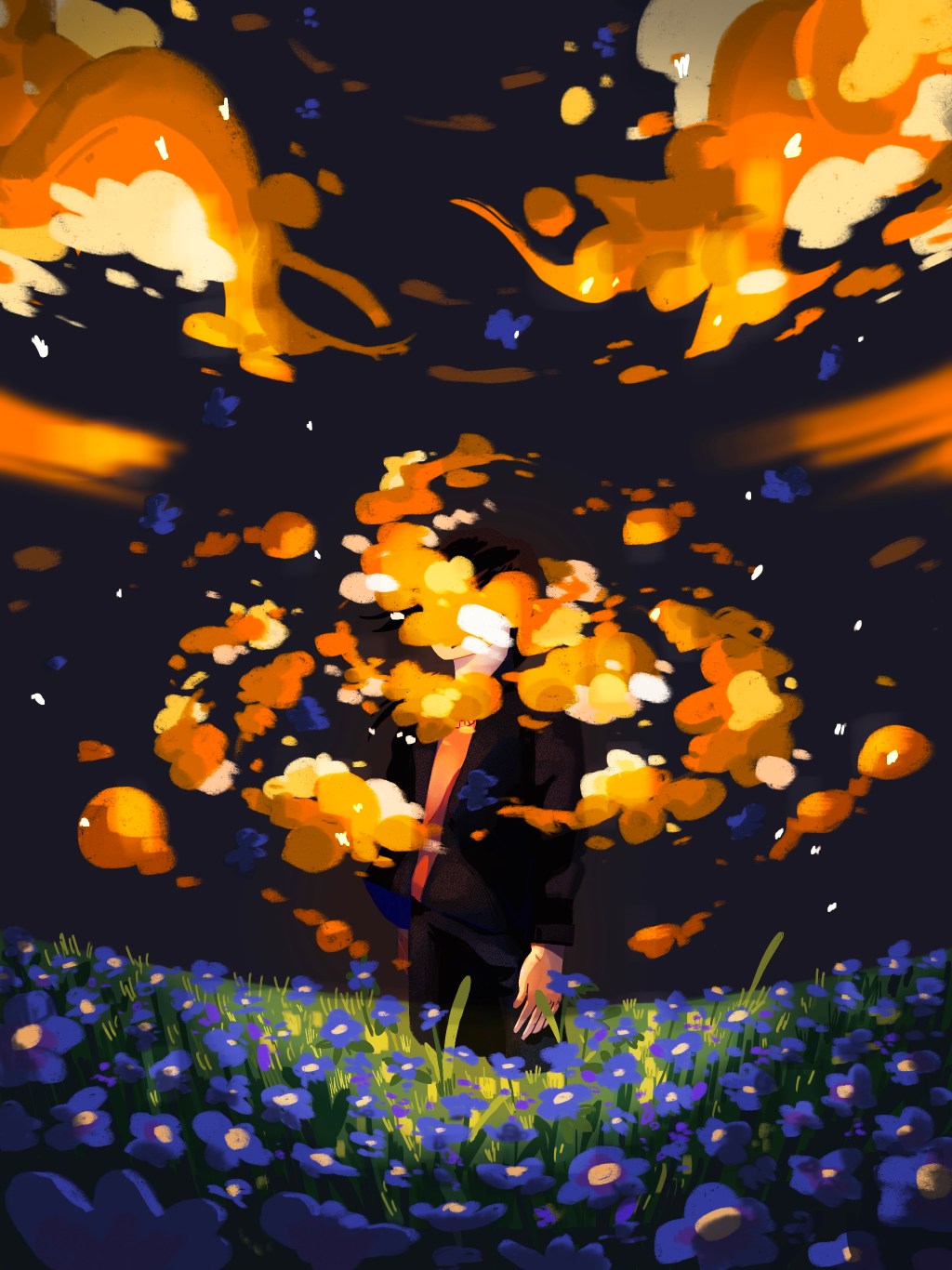
In the poem I selected, hope is implied to be comparable to light, and it’s a fleeting thing. This is why, in my painting, hope is represented by the bright clouds that have stark contrast to the rest of the palette: complementary to the navy background and blue flowers, the clouds are a bright mix of orange and yellow. Clouds are fleeting; they blow away in the wind, they fall and rain into different forms of water, combining with lakes and rivers.
Additionally, the poem states that hope – the “fleeting phantom” – is born at night, “When all the light has gone”, or in dark times. In the context of the riddle, it would be literally dark times. This is why my painting is placed in a dark place, in the middle of what seems to be a rather barren field. The only source of light is the person in the middle, with their own hope that also happens to be blinding them.
The phrase “Blind men follow in its wake” is both a hint to the answer and also an observation about hope; specifying “blind men” eliminates the possibility that “moon” is the answer to the riddle, as blind people would not follow the moon’s light if they’re unable to see. My other interpretation is that the men are “blind” because to have hope, you often have to ignore what is realistic. This is also why I chose to make the subject of my painting blinded by the clouds that are revolving around them. (And yes, the subject of my painting does not have a specified gender, so I just refer to them with they/them pronouns.)
The glow of hope will be eliminated once dawn comes, once the sun rises and everything is bright again. In the painting, hope is the brightest object in frame, but once dawn comes, hope will be gone, and instead the whole field will be illuminated with light. This is also represented in the flowers that I chose. I didn’t try too hard to make it clear what breed of flowers they are, but they’re forget-me-nots.
Historically, forget-me-nots do represent hope. Additionally, I also considered the name of forget-me-nots. Basically, you can only see the flowers once there’s light in the field- and since light is hope, you can only see the flowers once there is enough hope for them to be visible. The other scenario for seeing the flowers is once the sun rises, going back to the last line of the poem: “Until it dies at dawn”. Once people can see, once there is light, you may see the flowers. But of course, the sun will rise and set, so soon the sun will set and the flowers will be gone. Thus, it’s important to remember the sight of them; don’t forget them. Forget-me-nots… mhm.
I had many difficult stumbles with this project. The hardest I had to overcome was probably figuring out colors on digital drawings. I typically don’t use color in my art, I’ve always kept myself in the zone of graphite/charcoal. I do have a bit of color theory on my side, diverged from art camps that I had attended sporadically throughout my art career, so I utilized what I had.
My inexperience with color combined with my inexperience with digital art was a recipe for disaster. I remember watching a bunch of videos for procreate tricks and hacks, all those hour long “Painting Digitally for Beginners” videos, anything to help me get more familiar.
My concept was also pretty difficult. I actually had two ideas at first: one was something that I already had a reference photo for, and I was planning to do that one before I decided that I would rather challenge myself to do something new. My concept started as a thumbnail that I had no idea what I was gonna do with, and I couldn’t exactly find references either, since my idea was just a little too specific and abstract. I tried searching for things like “person in flower field reference”, but it didn’t come up with what I wanted, and even if I did find a good photo, the lighting from the center was not present in the image. I just had to wing it: consider lighting, everything, without a reference. Ugh.
Overall, my first experience with Procreate was pretty fun! I liked working digitally, so many things were easier, and having the knowledge up my sleeves is just handy for the future. It’s been a fun project!


Leave a Reply